Skip to content
Super prep for super weather! Getting your site flood-ready
It’s official. Summer 2026 was the UK’s hottest summer on record. It was also exceptionally dry, with drought conditions developing in several regions. England and Wales experienced their driest recorded July, receiving just 10% of its average rainfall—and for the south of England it was the driest month ever (in records dating back to 1836).
With settled weather continuing well into the autumn for many, site and facilities teams may be daring to hope that the year’s biggest weather risks are behind us. But after months of exceptionally dry conditions, the arrival of rainfall may bring them a very different set of challenges.
From dry ground to flood risk
After months with no rainfall, the ground is exceptionally hard and slower to absorb water. When heavy rain does arrive, it can simply run off the hard surface, increasing the risk of localised surface-water flooding.
Exacerbating the problem, when there’s a prolonged dry period, drainage is more prone to becoming clogged. Whether it’s dirt and leaves or grease and kitchen waste dried in the warm pipes, blockages build up without having frequent rainfall to flush them through.
All this means that even a short sharp shower can leave water with nowhere to go—putting entrances, walkways, equipment and other vulnerable areas of your site at heightened risk.

A record-breaking winter too?
This winter, there’s another good reason to get a head start on your flood preparation, with the prospect of another record-breaking weather event and potential for more unprecedented conditions heading for the UK—this time not the warm and sunny kind.
An El Niño weather pattern was identified in the Pacific earlier in the summer, with some reports describing it as the strongest ever measured for that time of year. The predicted impact of this “super” El Niño on the UK winter varies considerably—from minimal impact, to wetter, stormier weather, to dramatic headlines warning of a polar vortex and giant wall of rain and snow!
Super planning for super weather
However drastic the weather turns out to be this winter, the advice is clear: don’t wait for a rainy day to prepare your site for flooding. Flood guidance from the government recommends maintaining a business flood plan covering the risks to people, property and operations, as well as the actions to take before, during and after a flood. It also recommends checking that flood prevention products and warning systems are working properly.
The Flood handbook for your business, published by FloodMary.com, sets out practical measures businesses can take to minimise disruption and improve resilience. Some of these are long-term resilience measures, such as positioning valuable equipment and stock above ground level, raising electrical sockets and controls where practical, and backing up business-critical data often. Others are seasonal preparations that should be reviewed ahead of the winter months.
If you haven’t already, now’s the time to:
- Review your business flood plan and make sure everyone who needs to know understands their role
- Check flood warnings and understand your operation’s flood risk
- Make sure drains and gullies are clear
- Identify critical equipment, stock and infrastructure that could be vulnerable to water ingress
- Review your emergency procedures and business continuity plans
- Check that your flood protection equipment is fit for purpose, accessible and ready to deploy…
Flood protection equipment—your first line of defence
When flooding strikes, having physical flood protection equipment in place buys you valuable time, while you implement your contingency procedures. Products like flood barriers, diverters and absorbent kits are a key part of any robust flood plan. They can redirect, slow and in some cases stop water ingress altogether, helping to keep mess and damage contained so you can minimise operational disruption and recover faster.
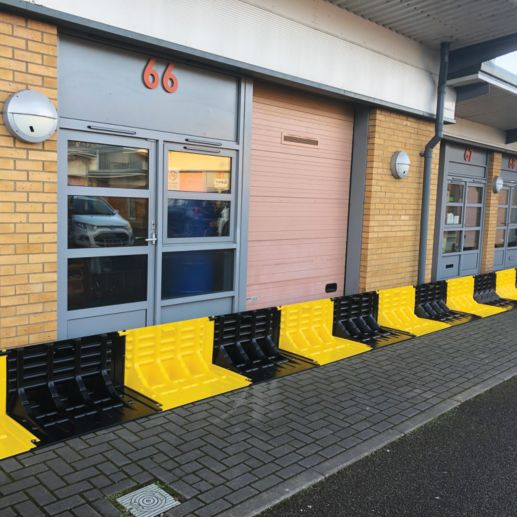
Take the time to routinely inspect your equipment for wear and tear. Keep it stored within easy reach—somewhere that the people who need to know know—so it’s ready for fast deployment when a threat is detected.
Is your flood defence protection fit for purpose?
Flood protection technology is continually evolving so it’s worth regularly reviewing the equipment you have on site and keeping an eye on new market developments so you can be confident you’re equipped with the best possible protection. At Manutan, our flood protection tackles water ingress in three ways so you can respond at different points around your site, blocking, diverting and absorbing water wherever it threatens.
1. Flood barriers
Flood barriers create a temporary defensive wall to physically stop water from getting in. Designed for compact storage and fast deployment, they can be used to protect critical access points like doorways, loading bays, walkways and site perimeters. From water-filled barriers to systems that use water pressure to strengthen their seal, they’re a highly effective solution during periods of heavy rainfall or flood conditions.
How do flood barriers work?
Flood barriers are modular, reusable systems that fit together to create a watertight wall between rising floodwater and the protected area. Hollow barriers use passive water ingress, self-filling with floodwater to anchor themselves to the ground. Panel designs use gaskets and the downward pressure of the incoming water to create a watertight seal. Both are nestable/stackable so they can be neatly stored away until called upon.
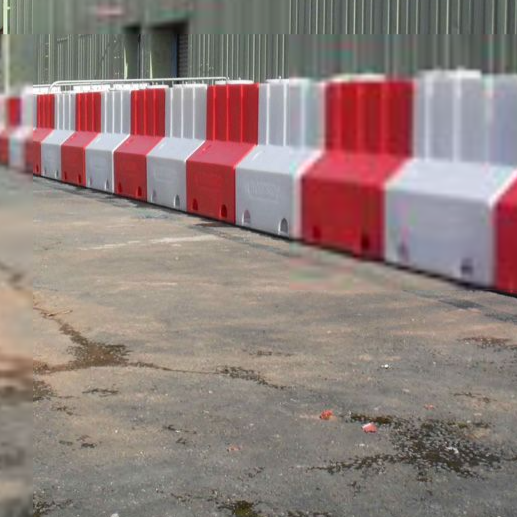 Browse: FloodStop pre-fill flood defence barriers
Supplied in red or white, these modular barriers fill automatically with incoming floodwater and a unique foam gasket base seals against the ground, forming a stable flood defence system. Available in 500mm and 900mm height, the barriers link together easily to form emergency or semi-permanent protection.
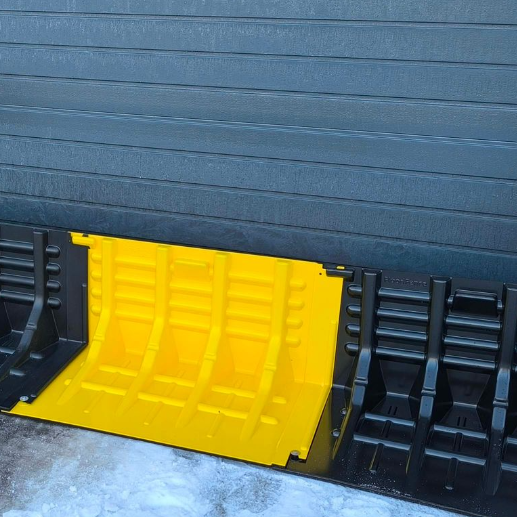 Browse:Mobile flood barrier fence
This self-balancing barrier incorporates a slimline base gasket, harnessing the pressure of advancing floodwater to create a secure seal to hard ground. When fitted together, the effective linear length of each unit is 91cm, protecting against water flows up to 40cm deep. Corner units allow you to build flexible configurations as required.
2. Flood absorption
Not every flood risk can be stopped at the door. Water can enter through vulnerable points. Leaks, overflows and localised flooding can threaten equipment and busy walkways. When this happens, rapid absorption helps prevent water spreading further. From versatile strips to absorbent flood sacks our range of products are lightweight, easy to position and quick to soak up large amounts, keeping affected areas safer and more manageable.
How do flood absorption products work?
Our absorption solutions use superabsorbent polymer (SAP) which swells on contact with water and can absorb many times its own weight in liquid. Water is locked into the absorbent material rather than simply being held on the surface, helping prevent leakage during handling and removal. The materials used are non-toxic and non-hazardous making clean-up and disposal safe and straightforward.
 Browse: HydroSacks
HydroSacks offer a smart, lightweight alternative to traditional sandbags, weighing less than 10% of their equivalent weight (before activation). Easy to store and deploy single-handedly, each sack absorbs up to 20 litres of water to create an effective flood barrier. When stacked, they help protect against rising water and remain effective for up to six months after saturation.
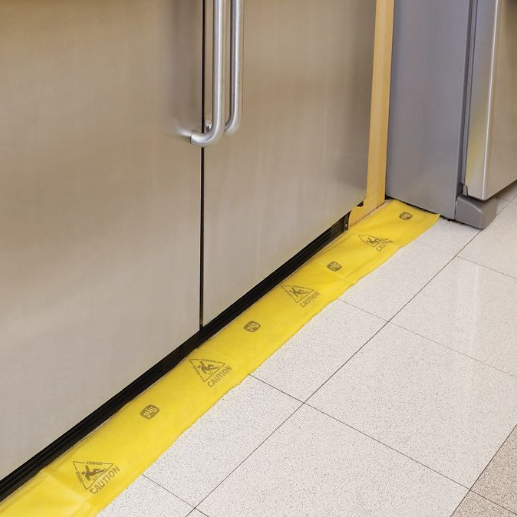 Browse: Absorb-&-Lock strips
Designed for fast, effective water control, Absorb-&-Lock strips expand on contact with water to contain leaks and prevent further spread. Available in 1.5m and 3m lengths, their low-profile design fits easily into tight spaces, while the high-vis finish helps reduce trip hazards. Ideal for use under doors and around machinery, vents and walkways.
Shop our flood absorption range
3. Leak diverters
Heavy rainfall will quickly expose weaknesses in ageing or damaged roof coverings and leaky ceilings. Left unmanaged, water ingress then leads to slip hazards, damaged stock and equipment, disrupted operations and costly repairs. Leak diverters provide a temporary instant solution by capturing and channelling water away from affected areas until a permanent repair can be made. Easy to deploy and available with a range of fixing methods to suit your ceiling construction, they help protect people, property and productivity during wet weather.
How do leak diverters work?
Leak diverters attach to the ceiling or roof, suspended beneath the leak like an upside-down umbrella, safely collecting and funnelling the water into a container or drainage point. They can be secured using spring-loaded poles and hooks, magnets for metal structures, or plasterboard fixings, providing a versatile solution for every kind of ceiling with minimal disruption to the surrounding area.
 Browse: Quick-Deploy Leak Diverter
Designed for speedy emergency response, this leak diverter combines a durable collection tarp with spring-loaded support poles for simple installation. The non-permeable tarp is vinyl coated, resistant to punctures, UV and mildew—ready for repeated use. If you don’t have one of these in your emergency kit, get one!