Skip to content
Why smarter battery disposal should be your new year’s resolution!
Christmas. The season of giving… and of throwing stuff away. From old Christmas trees to leftover turkey, the bin men and women have their work cut out over the festive period. But prickly branches and mouldy food are the least of their worries as a danger lurks in the new year rubbish capable of turning an everyday shift into a life-or-death emergency.

Let’s be honest, when Santa brings you a mobile phone upgrade, or your string of Christmas lights start to lose their twinkle, it’s tempting to drop the faulty fairies and demoted device straight into the nearest household bin along with all your other rubbish. Hey, what’s the worst that can happen?
Lithium-ion disposal—the worst that can happen

What you may not realise is that seemingly harmless electrical items like light-up Christmas decs have a darker side. LED lights, mobile phones, toys, tools, toothbrushes and most rechargeable devices contain lithium-ion battery cells. And while these rechargeable heroes power much of our modern-day living, they can be sensitive little troublemakers, thanks to their delicate internal components. A little undue pressure and the component that separates the cathode (positive) and anode (negative) is easily damaged causing the cell to short circuit. This can set off a rapid and intense temperature rise—a chain reaction known as thermal runaway (TR)—which can lead to fire or even an explosion.
So being squashed, jostled or otherwise crushed in the back of a bin lorry is really not good for them. If they do survive their trip to the tip, lithium-ion cells pose an even greater risk when they make it to their final resting place. Compacted under landfill, electricals can spark fires that burn underground for days, sometimes even weeks. During thermal runaway, cells generate their own heat and toxic gases (off-gassing) which spreads to other cells, making these types of fires especially difficult to extinguish.
Sounds dramatic? It is. The danger is real and growing, thanks to the increasing popularity and convenience of electronic rechargeables. In 2023 the Fire and Rescue People reported over 1,200 fires in bin lorries and waste sites caused by batteries, up from 700 the previous year. But there is good news—these fires are easily preventable. From mobile phone recycling to disposal of vapes and larger electricals, you can drop these items into your local household waste recycling centre when you’re done with them, where they’ll be segregated from other waste.
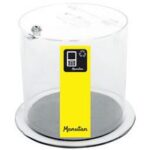
Nowadays most supermarkets and electronics retailers also collect spent batteries—and you can too! Check out these battery collection bins in the Manutan range and help to encourage safer electrical waste disposal in your workplace.
A happy ending?
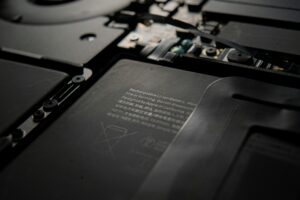 Lithium-ion disposal done correctly negates the risk of lorry and landfill fire. But that’s only half the story. If you have lithium-ion storage in your workplace, you face similar fire hazards because it’s not just physical crushing that compromises lithium-ion batteries. Damage can occur through overheating, excess humidity or overcharging. Additionally, prolonged storage at low charge (known as deep discharge) can lead to irreversible cell degradation and a reduction in overall performance.
These volatile fellas need special care and attention throughout their lifecycle. Stash them on a shelf without proper ventilation, temperature control or fire precaution and you could be in for trouble.
Lithium-ion storage—what employers need to know
Under existing health and safety regulations, as an employer you have a legal duty to manage the fire and safety risks associated with lithium-ion batteries, which includes conducting a thorough risk assessment and implementing appropriate safety measures. It’s essential that whoever conducts the assessment understands all the risks associated with battery storage including thermal runaway, off-gassing, risk of fire spread and explosion, and the conditions specifically needed for lithium-ion storage. They will need to consider:
- Temperature control—both high and low temperatures can damage lithium-ion cells increasing the risk of thermal runaway, so your batteries should be stored between 5°C and 20°C (40–68°F), away from direct sunlight and other heat sources.
- Ventilation—damp or humid conditions accelerate battery degradation. Electrolyte in the cell contains lithium salt which reacts with moisture to form highly toxic hydrofluoric acid so the storage area should be kept below 50% relative humidity.
- Impact protection—stacking or rough handling increases the risk of impact, damage or puncturing, leading to thermal runaway or chemical leaks. Ideally your storage solution should have individual, compartmented spaces to protect each battery.
- Fire safety—it’s important to keep lithium-ion cells away from flammable materials, ideally in non-conductive, fire-resistant containers with a dedicated smoke or fire alarm installed in the area to provide an immediate alert in the event of overheating or fire.
- Charging levels—storing either fully charged or entirely depleted batteries will put a strain on the cells, increasing the risk of degradation, failure and fire. Lithium-ion cells should instead be stored at partial charge, between 40 to 60%.
- Access management—a secure environment is best for your lithium-ion cells so you can manage their authorised use—including staff training and compliance—and reduce the risk of theft, manhandling and accidental damage.
Purpose-built battery storage
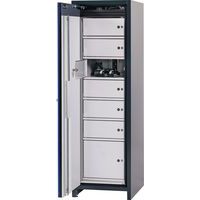 By far the simplest, safest and most cost-effective way to meet all of these requirements is by using purpose-built lithium-ion storage. That way you’ll ensure safe and secure storage of the lithium-ion batteries in your workplace, minimising the risk of hazards while prolonging the performance and lifespan of these most high-maintenance assets.
Manutan provides lithium-ion storage solutions in all shapes and sizes, with charging and passive (non-charging) storage options to suit most operational workflows. Designed to keep lithium-ion batteries safe from temperature fluctuations, impact and the other factors that cause thermal runaway, many of the cabinets in our range have built-in fire alarms, with some providing up to 120 minutes’ fire resistance (tested to EN 14470-1 standards) as a further safety back-up.
Other practical design features include:
- extraction units on top of the cabinets to prevent heat building up during battery charging
- individually insulated shelves so battery fire doesn’t spread to other storage levels
- smoke detectors and temperature sensors that link up to your building’s alarm system
- 3-point locking devices combining convenient operation with safety of closed doors in case of fire
- LED display visual alarms to alert you to problems without opening the cabinet door
- adjustable feet for uneven floors and single-handed door opening mechanisms for easy use
As the commercial and industrial storage experts, Manutan has everything you need to store lithium-ion cells on your site safely and securely. From anti-static zip-top bags to high-security steel charging safes, our trusted solutions will give you peace of mind, knowing the only items you’ll find roasting on an open fire at Christmas will be chestnuts!
Explore the full range at manutan.co.uk/lithium-ion-storage