Skip to content
The new waste management regulations—one year on
It’s now a year since new waste management regulations came into force in England, introducing mandatory separation of key waste streams. And while some organisations have hit the ground running, boosting recycling rates from day one, for others the road to compliance has been a little bumpier, with processes still bedding in and lessons still being learned.
A quick reminder of the rules?
 The Separation of Waste (England) Regulations 2025 came into effect on 31 March last year, bringing England closer in line with what was happening across the border in Wales. In summary, businesses with 10 or more full-time employees must now separate dry recyclables, food waste and general waste on site, including rubbish produced by staff, visitors and customers. If you’ve grabbed a coffee or lunch out recently, you’ll have probably clocked the new multi-bin line-up in action.
Known by its friendlier name, the Simpler Recycling initiative aims to increase recycling rates, cut landfill and give sustainability efforts a proper boost across the board.
So how’s it going?
As the regs approach their first anniversary (that flew by, didn’t it?) now’s a good time to pause and take stock. How’s your workplace adapted this past year? What’s been working… and what hasn’t?
Whether you overhauled your entire waste setup last year, or simply shuffled a few bins around, it’s worth revisiting things now to see how people are interacting with your system day to day. Pick a typical operating week (avoid peak chaos) and track what’s happening. This might involve:
- regular visual checks of your bin levels
- taking photos through the day
- recording the number of sacks used
- weighing what’s collected (if possible)
- logging volumes across each waste stream
Staff surveys can also be gold dust. Do teams understand why separation matters? Are the bins in handy places? Keeping feedback anonymous will encourage honesty. You never know where, or who, your next game-changing idea might come from.
Getting to grips with your waste landscape
A simple review will reveal how effectively your waste is being separated on site and how closely you’re aligning with legislation… ahead of that inevitable compliance audit.
Whenever new legislation lands there’s always a settling-in period, so if you uncover a few teething problems, don’t panic. You’re in good company—businesses of all sizes are still fine-tuning their setup. And at Manutan UK we’re here to help you get sorted, literally. With the right layout, signage and sorting solutions in place, cleaner waste separation will soon become second nature—and compliance will naturally follow.
Getting down to basics
No longer just a matter of hygiene, waste management is now about sustainability, reputation, cost control and legal compliance. That’s why we’re slightly obsessed with waste and recycling management at Manutan UK and partner with businesses to provide advice, solutions and support.
We see what happens when a company has the wrong waste setup in place and we know how to turn it around. Embedding best practices into your organisation’s culture is key. That takes planning and in our recent article we explain how applying a process framework like the 5S methodology can support your efforts.
Every successful system begins with having the right waste containers in all the right places. So let’s get down to basics with a closer look at the waste streams you need to sort, and the bins that will help you do it well.
-
Dry recyclables
Paper, cardboard, plastic and metal all fall into this category. Whether you can collect them together or need to separate them further will depend on your waste carrier.
What to consider when setting up your dry recycling bin station:
- Use colour-coded lids to help users quickly identify the correct stream
- Add clear, consistent labelling with text and pictograms
- Position bins in high-traffic areas such as entrances, kitchens and print rooms
A little help from Manutan:
Our 60–80L waste sorting bins offer a choice of lids with cut-outs to suit the rubbish stream in colours to support coding across your workplace. These 60L recycling bins also provide colour-coded, cut-out lids, compact design and built-in handles for easy lifting and transporting. For even smaller spaces like meeting rooms or reception areas, check out our 3-compartment steel sorting bin offering an all-in-one unit for separating waste, available in a choice of sizes and finishes.
-
Glass
Technically also a dry recyclable, glass should be collected separately for staff safety and better recycling quality. Glass waste includes bottles and jars from kitchens, break rooms and dining areas.
What to consider when setting up your glass bin station:
- Use clearly marked, dedicated glass-only bins
- Choose durable, easy-to-clean materials suitable for heavier waste
- Position glass bins in areas where bottles and jars are most likely to be used
A little help from Manutan:
Glass waste containers at Manutan are designed with secure depositing and easy, safe emptying in mind. This 60L steel recycle bin is ideal for glass recycling in offices and staff kitchens, available in a choice of colours, combining durability with a professional finish. For larger volumes, our 240L portable recycling bin is purpose built for glass collection, providing a secure, high-capacity option that’s easy to manoeuvre.
-
Food waste
Tea bags, coffee grounds, fruit peelings, lunchtime leftovers—if it’s food, it must be collected separately. Even if it’s brought in from home, and no matter how little is generated.
What to consider when setting up your food waste station:
- Provide small caddies in kitchens to encourage correct separation at source
- Use liners suitable for food waste to maintain hygiene standards
- Empty food bins regularly to prevent odours and pest issues
- Train staff on what can and can’t be included (e.g. packaging must be removed)
A little help from Manutan:
Manutan’s range of food waste bins and kitchen caddies are designed with hygiene and practicality in mind. Our stylish stainless steel food waste bin doesn’t just look good, it offers durable, hands-free pedal operation, available in two sizes to suit office kitchens or larger catering operations. These 90L plastic food waste bins have rounded corners making them easier to clean than conventional bins, available in various colours to fit with your colour-coded system.
-
General waste
This is the non-recyclable remainder: composite packaging, tissues, contaminated materials and items not accepted by your recycling provider. It’s usually your most expensive stream so minimising it pays off.
What to consider when setting up your general waste bin station:
- Clearly label general waste to avoid recyclables being incorrectly disposed of
- Conduct periodic waste audits to identify opportunities to reduce this stream
- Put recycling bins next to general waste bins to encourage correct decision-making
- Monitor volumes and collection frequency to control costs
A little help from Manutan UK:
 General rubbish bins come in all shapes and sizes at Manutan, from our 1.5 litre tabletop swing bins (yes, they’re a thing and they’re very cute) to our 660-litre waste dumpsters in a choice of blue, green or yellow. Despite their size the dumpsters are easy to position thanks to swivel wheels and handles on three sides. (And we think they’re just as cute.)
Taking it outside
Remember, the Simpler Recycling regulations apply outside too. If you manage any outdoor space, from theme parks and public gardens to staff break areas, you need to follow the same rules. Manutan UK supplies a huge range of options for clean, compliant outside spaces.
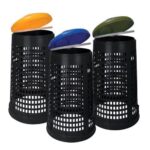 Our wood-effect sorting bin provides dual-stream collection while blending with the environment. These perforated bins may look like a Dalek invasion but they are in fact super-versatile bin bag holders, built for easy maintenance and collection in remote locations. Looking for a more traditional style? Our steel tulip litter bin puts a modern spin on a timeless park classic. Browse the full outdoor range here.
Who’s responsible?
Everyone! Waste collection and separation isn’t just a task for cleaning teams anymore, it’s a shared mission across the workplace. And while, right now, the rules apply to organisations with 10+ full-time employees, from next March they’ll extend to ALL organisations, even small businesses run from home. That’s a lot of people getting friendly with extra bins.
And if we don’t comply?
If you’ve been slow to adapt your recycling setup this past year, or you’re thinking “we’re doing fine as we are”, be careful not to grow too complacent. Firstly, you’re missing out on some very real benefits of efficient waste separation:
- Environmental impact: improving your recycling rates and cutting landfill helps reduce the harm caused by improper waste disposal
- Cost savings: streamlining waste processes and increasing recycling efficiency lowers disposal costs, delivering long-term financial savings
- Reputation: demonstrating environmental responsibility and strengthening your CSR credentials builds trust with customers, partners and employees
Secondly, there are clear risks to ignoring the rules. At any time, a customer or member of the public could report concerns about your waste practices. Data from your local authority or waste contractor may also flag non-compliance. The Environment Agency can issue a compliance notice, and continued failure to act could result in fines or legal action. In short, compliance isn’t optional—and the cost of ignoring it can be far greater than the effort required to get it right.
Regulation-ready waste management, let’s go
If waste regulation has been on your mind this past year and you know you’re not quite there yet, it’s time to “take the wheelie by the handles”. With the right containers and a clear system in place, you won’t just meet today’s requirements, you’ll futureproof your business as the regulations evolve with the growing circular economy. Plastic film recycling rules are next on the horizon!
At Manutan UK you can access everything you need to tackle your waste challenges and set up a streamlined, scalable, cost-effective system. With our huge choice of recycle bins, waste containers and sacks for indoors and out—with FREE delivery on everything—it’s easy to build a regulation-ready waste management system across your workplace.
Explore our waste management solutions here.